Publications
Research papers, full abstracts, and links to code and project websites.
-
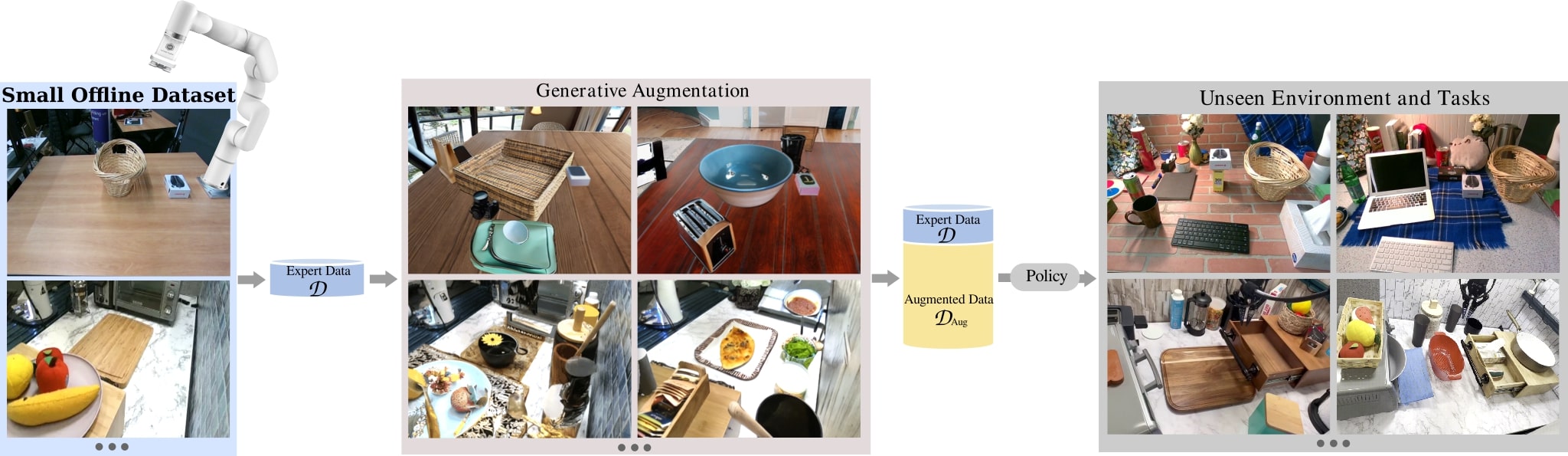 Semantically Controllable Augmentations for Generalizable Robot LearningThe International Journal of Robotics Research (IJRR), 2025
Abstract
Generalization to unseen real-world scenarios for robot manipulation requires exposure to diverse datasets during training. However, collecting large real-world datasets is intractable due to high operational costs. For robot learning to generalize despite these challenges, it is essential to leverage sources of data or priors beyond the robot’s direct experience. In this work, we posit that image-text generative models, which are pre-trained on large corpora of web-scraped data, can serve as such a data source. These generative models encompass a broad range of real-world scenarios beyond a robot’s direct experience and can synthesize novel synthetic experiences that expose robotic agents to additional world priors aiding real-world generalization at no extra cost. In particular, our approach leverages pre-trained generative models as an effective tool for data augmentation. We propose a generative augmentation framework for semantically controllable augmentations and rapidly multiplying robot datasets while inducing rich variations that enable real-world generalization. Based on diverse augmentations of robot data, we show how scalable robot manipulation policies can be trained and deployed both in simulation and in unseen real-world environments such as kitchens and table-tops. By demonstrating the effectiveness of image-text generative models in diverse real-world robotic applications, our generative augmentation framework provides a scalable and efficient path for boosting generalization in robot learning at no extra human cost.
-
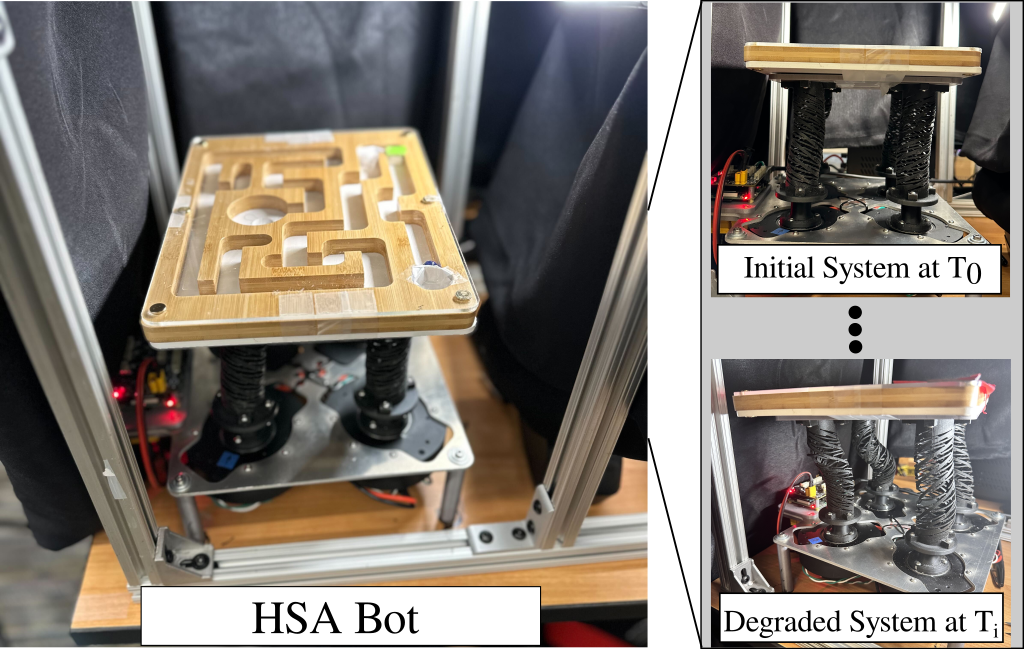 Duolingo: Dynamics Utilization for Online Translation of ActionsIn IEEE International Conference on Robotics and Automation (ICRA), 2025
Abstract
Robots in the real world experience wear and tear, leading to changing system dynamics. This challenge is particularly exacerbated for non-rigid systems such as soft robots or robotic systems made of metamaterials with hysteresis. This setting results in a challenging problem for most learning-based controllers that typically rely on the assumption that the system dynamics remain fixed over time. In the absence of explicit mechanisms to account for this change in dynamics, learning-based control algorithms show considerable degradation in performance over time. In this work, we consider a particular class of dynamics shift in under-actuated systems, that is localized to the dynamics of the fully actuated robot itself, while independently leaving the dynamics of the environment unchanged. This captures real-world phenomena such as fatigue or hysteresis in robotic systems. In this setting, we propose an efficient algorithm that can account for dynamics shift. Using a simple calibration procedure, we propose a technique for learning a non-linear “action-translation” model that can capture the localized shift in dynamics. This enables continual learning and transfer despite considerable dynamics shift during the learning process. We demonstrate the efficacy of this procedure on several tasks in simulation, as well as a real-world robotic system - a 4 DoF electrically driven handed shearing auxetic (HSA) platform.
-
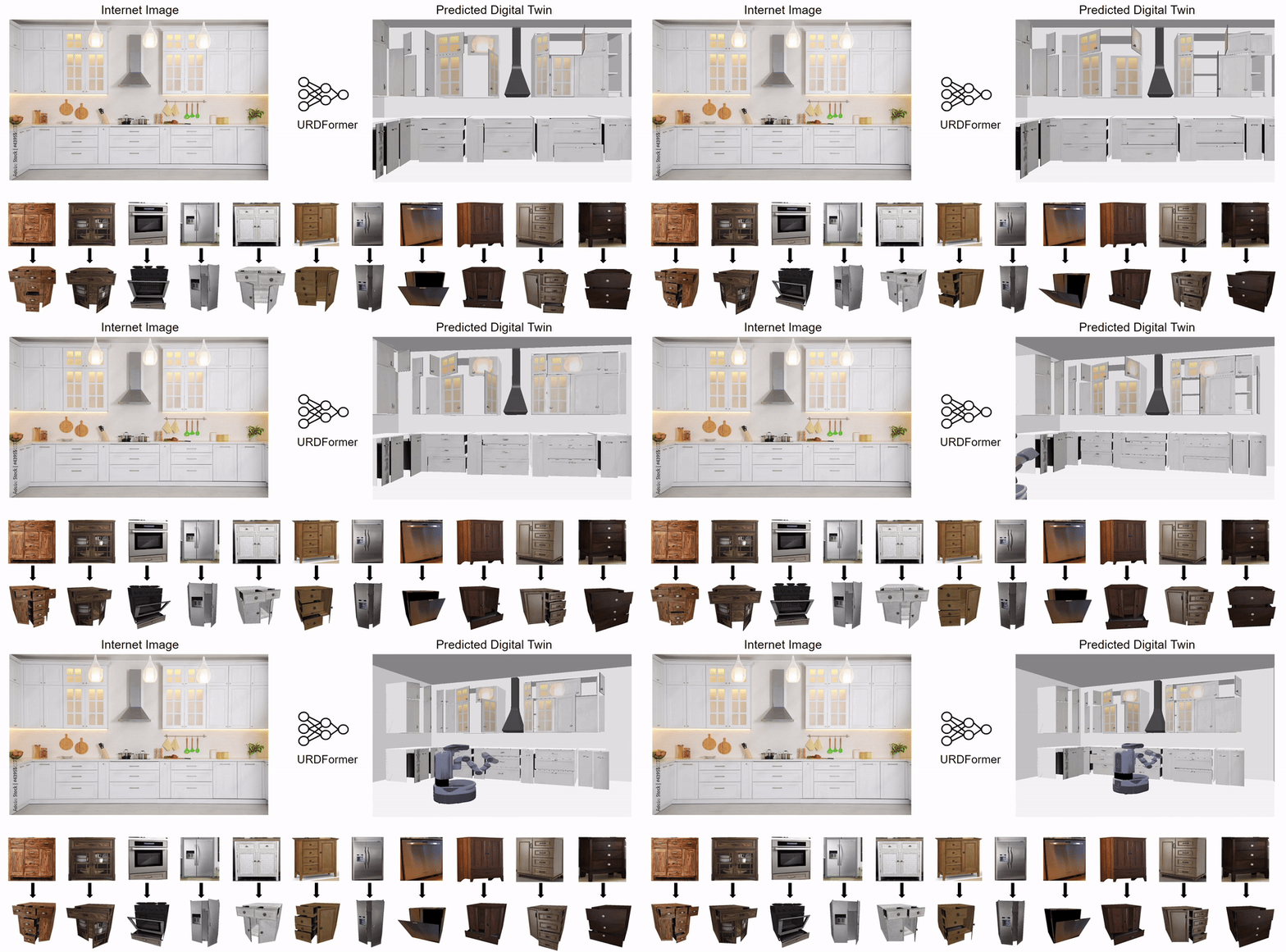 URDFormer: A Pipeline for Constructing Articulated Simulation Environments from Real-World ImagesIn Robotics: Science and Systems (RSS), 2024Oral Presentation at CoRL TGR workshop
Abstract
Constructing accurate and targeted simulation scenes that are both visually and physically realistic is a significant practical interest in domains ranging from robotics to computer vision. However, this process is typically done largely by hand - a graphic designer and a simulation engineer work together with predefined assets to construct rich scenes with realistic dynamic and kinematic properties. While this may scale to small numbers of scenes, to achieve the generalization properties that are requisite of data-driven machine learning algorithms, we require a pipeline that is able to synthesize large numbers of realistic scenes, c omplete with “natural” kinematic and dynamic structure. To do so, we develop models for inferring structure and generating simulation scenes from natural images, allowing for scalable scene generation from web-scale datasets. To train these image-to-simulation models, we show how effective generative models can be used in generating training data, the network can be inverted to map from realistic images back to complete scene models. We show how this paradigm allows us to build large datasets of scenes with semantic and physical realism, enabling a variety of downstream applications in robotics and computer vision.
-
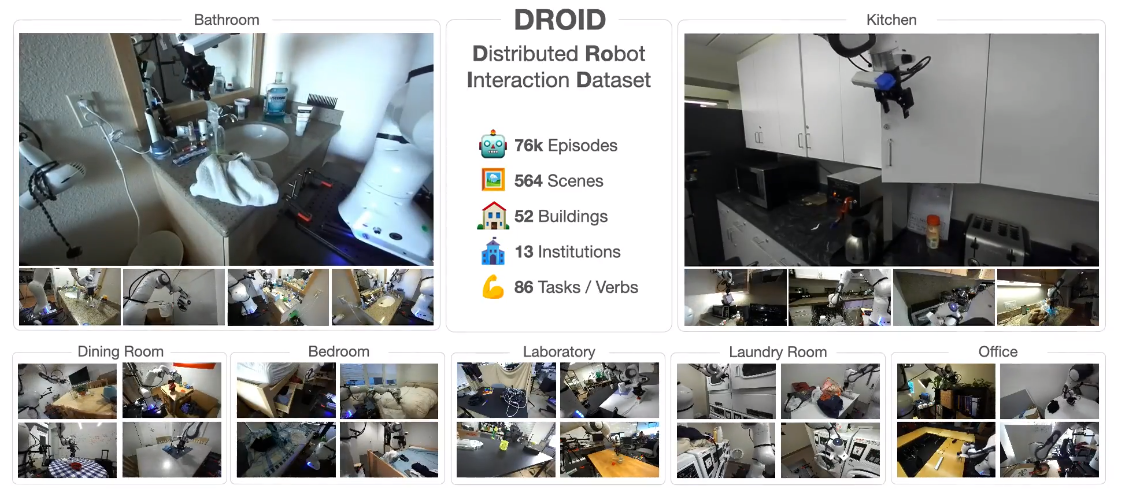 DROID: A Large-Scale In-The-Wild Robot Manipulation DatasetIn Robotics: Science and Systems (RSS), 2024
Abstract
The creation of large, diverse, high-quality robot manipulation datasets is an important stepping stone on the path toward more capable and robust robotic manipulation policies. However, creating such datasets is challenging: collecting robot manipulation data in diverse environments poses logistical and safety challenges and requires substantial investments in hardware and human labour. As a result, even the most general robot manipulation policies today are mostly trained on data collected in a small number of environments with limited scene and task diversity. In this work, we introduce DROID (Distributed Robot Interaction Dataset), a diverse robot manipulation dataset with 76k demonstration trajectories or 350h of interaction data, collected across 564 scenes and 86 tasks by 50 data collectors in North America, Asia, and Europe over the course of 12 months. We demonstrate that training with DROID leads to policies with higher performance, greater robustness, and improved generalization ability. We open source the full dataset, code for policy training, and a detailed guide for reproducing our robot hardware setup.
-
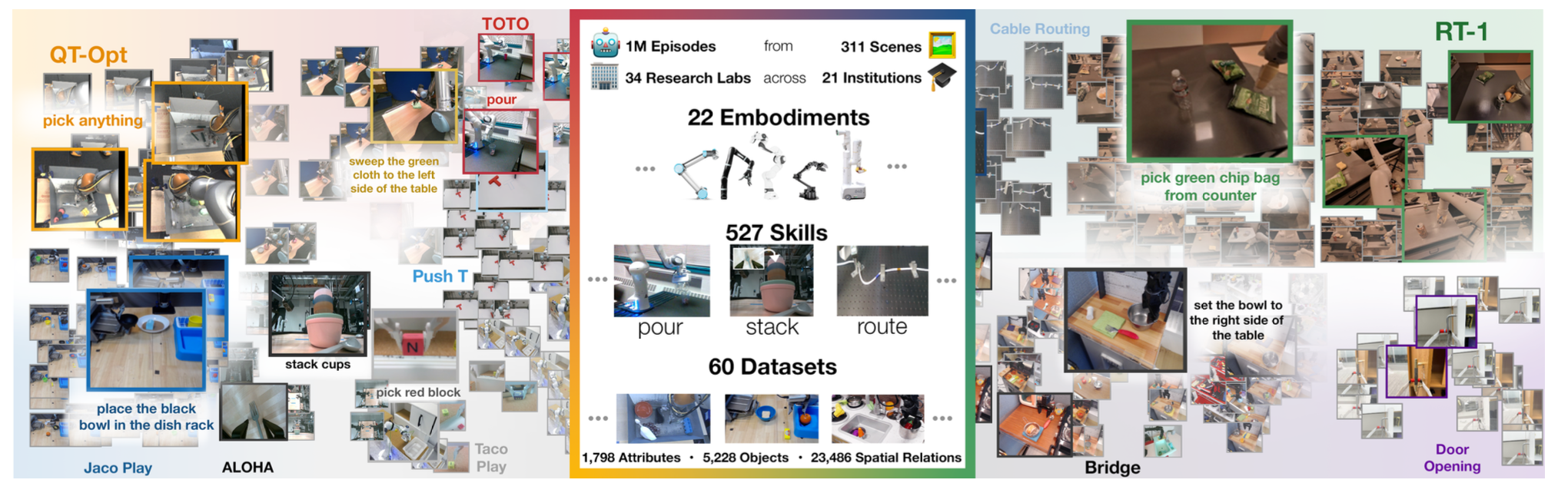 Open X-Embodiment: Robotic Learning Datasets and RT-X ModelsIn IEEE International Conference on Robotics and Automation (ICRA), 2024Best Conference Paper Award
Abstract
Large, high-capacity models trained on diverse datasets have shown remarkable successes on efficiently tackling downstream applications. In domains from NLP to Computer Vision, this has led to a consolidation of pretrained models, with general pretrained backbones serving as a starting point for many applications. Can such a consolidation happen in robotics? Conventionally, robotic learning methods train a separate model for every application, every robot, and even every environment. Can we instead train “generalist” X-robot policy that can be adapted efficiently to new robots, tasks, and environments? In this paper, we provide datasets in standardized data formats and models to make it possible to explore this possibility in the context of robotic manipulation, alongside experimental results that provide an example of effective X-robot policies. We assemble a dataset from 22 different robots collected through a collaboration between 21 institutions, demonstrating 527 skills (160266 tasks). We show that a high-capacity model trained on this data, which we call RT-X, exhibits positive transfer and improves the capabilities of multiple robots by leveraging experience from other platforms.
-
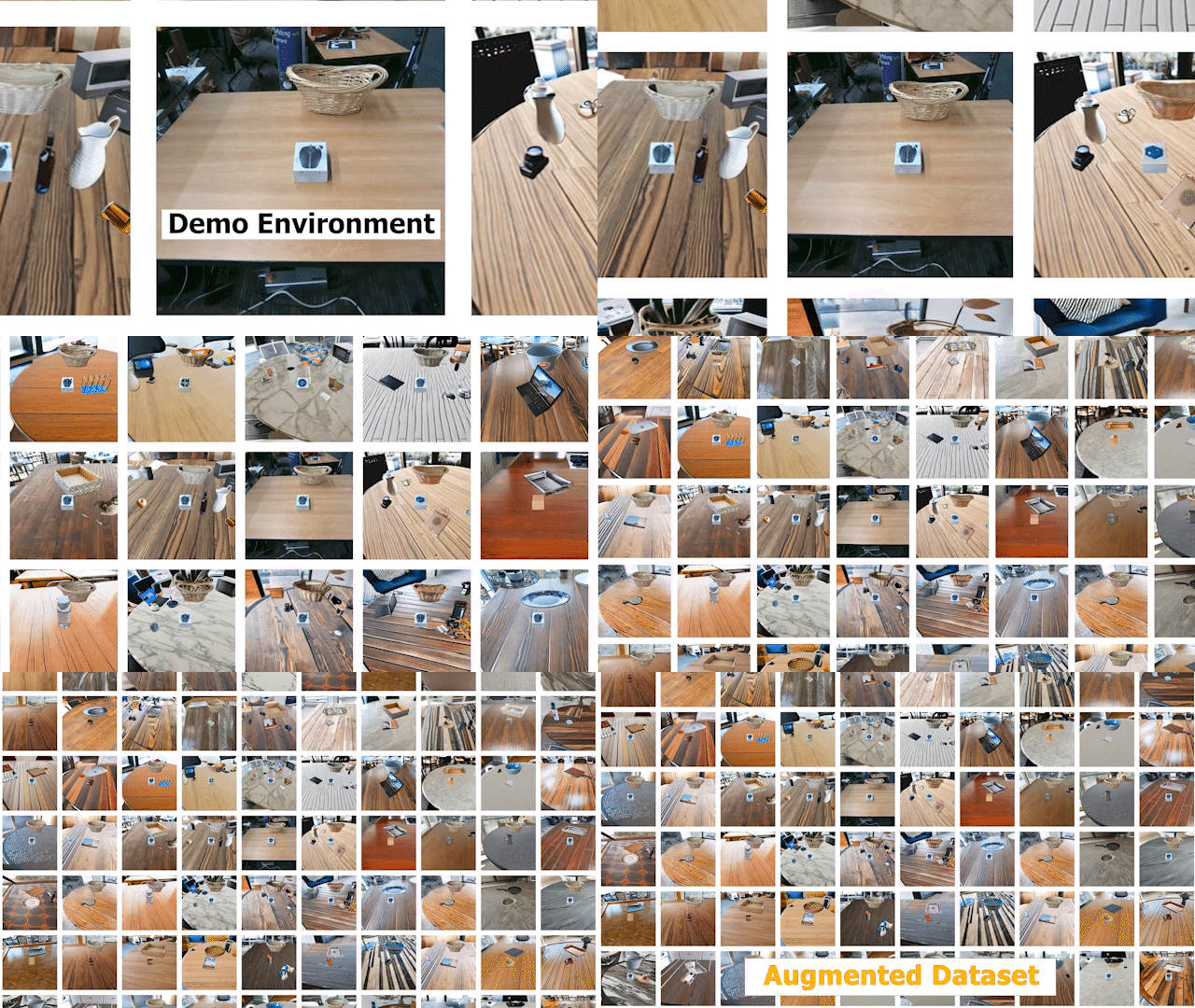 GenAug: Retargeting Behaviors to Unseen Situations via Generative AugmentationIn Robotics: Science and Systems (RSS), 2023Best System Paper Finalist
Abstract
Robot learning methods have the potential for widespread generalization across tasks, environments, and objects. However, these methods require large diverse datasets that are expensive to collect in real-world robotics settings. For robot learning to generalize, we must be able to leverage sources of data or priors beyond the robot’s own experience. In this work, we posit that image-text generative models, which are pre-trained on large corpora of web-scraped data, can serve as such a data source. We show that despite these generative models being trained on largely non-robotics data, they can serve as effective ways to impart priors into the process of robot learning in a way that enables widespread generalization. In particular, we show how pre-trained generative models can serve as effective tools for semantically meaningful data augmentation. By leveraging these pre-trained models for generating appropriate “semantic” data augmentations, we propose a system GenAug that is able to significantly improve policy generalization. We apply GenAug to tabletop manipulation tasks, showing the ability to re-target behavior to novel scenarios, while only requiring marginal amounts of real-world data.
-
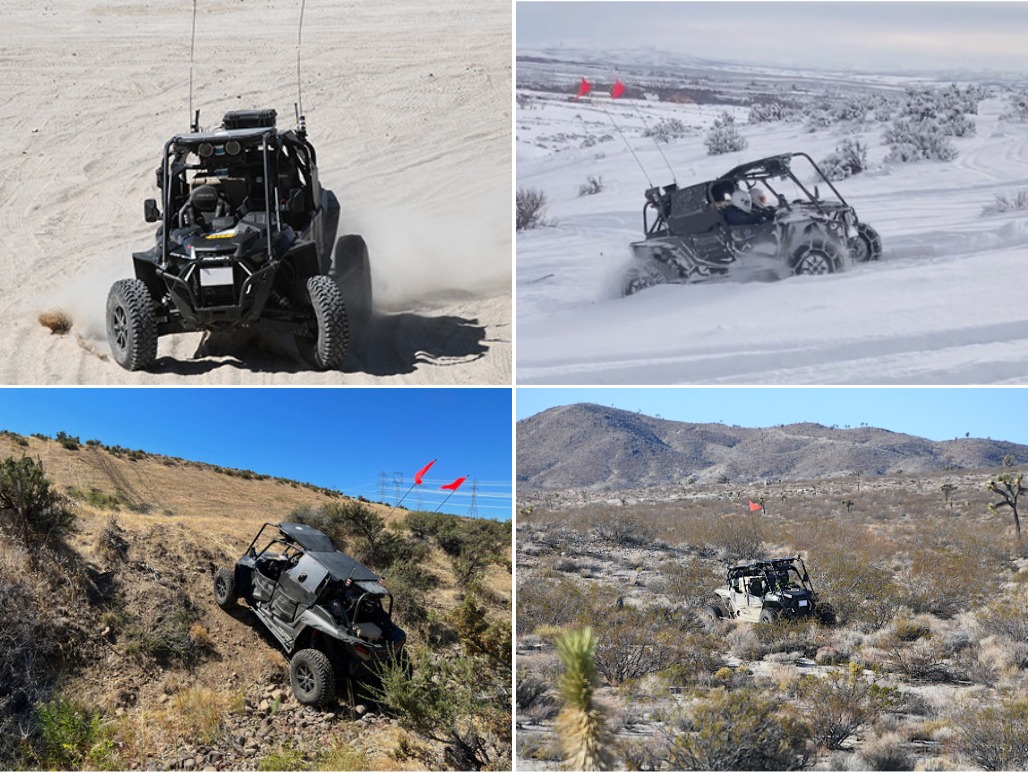 TerrainNet: Visual Modeling of Complex Terrain for High-speed, Off-road NavigationIn Robotics: Science and Systems (RSS), 2023
Abstract
Effective use of camera-based vision systems is essential for robust performance in autonomous off-road driving, particularly in the high-speed regime. Despite success in structured, on-road settings, current end-to-end approaches for scene prediction have yet to be successfully adapted for complex outdoor terrain. To this end, we present TerrainNet, a vision-based terrain perception system for semantic and geometric terrain prediction for aggressive, off-road navigation. The approach relies on several key insights and practical considerations for achieving reliable terrain modeling. The network includes a multi-headed output representation to capture fine- and coarse-grained terrain features necessary for estimating traversability. Accurate depth estimation is achieved using self-supervised depth completion with multi-view RGB and stereo inputs. Requirements for real-time performance and fast inference speeds are met using efficient, learned image feature projections.
-
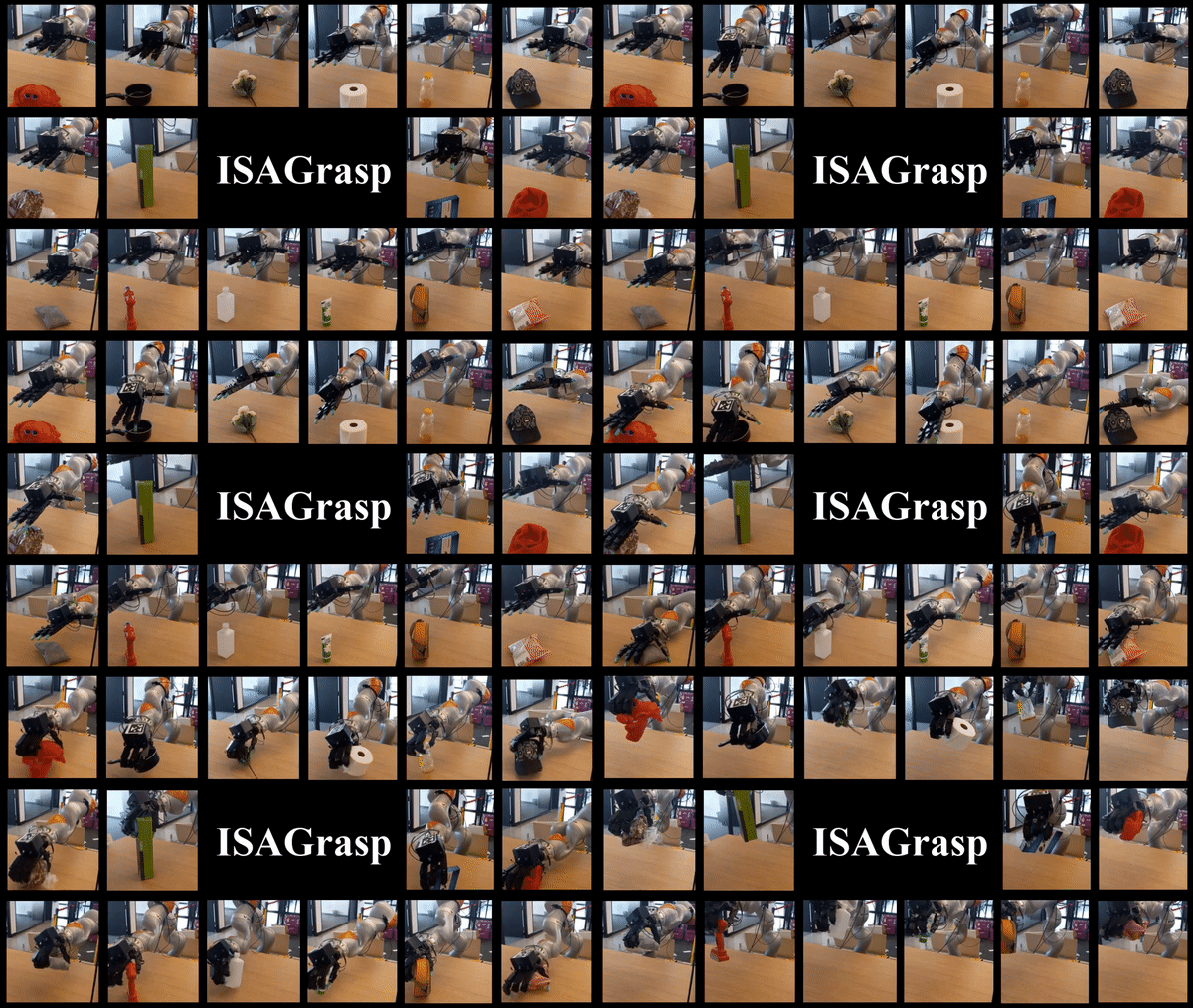 Learning Robust Real-world Dexterous Grasping Policies via Implicit Shape AugmentationIn Conference on Robot Learning (CoRL), 2022
Abstract
Dexterous robotic hands have the capability to interact with a wide variety of household objects to perform tasks like grasping. However, learning robust real world grasping policies for arbitrary objects has proven challenging due to the difficulty of generating high quality training data. In this work, we propose a learning system (ISAGrasp) for leveraging a small number of human demonstrations to bootstrap the generation of a much larger dataset containing successful grasps on a variety of novel objects. Our key insight is to use a correspondenceaware implicit generative model to deform object meshes and demonstrated human grasps in order to generate a diverse dataset of novel objects and successful grasps for supervised learning, while maintaining semantic realism. We use this dataset to train a robust grasping policy in simulation which can be deployed in the real world.
-
 DexTransfer: Real World Multi-fingered Dexterous Grasping with Minimal Human DemonstrationsIn Robotics: Science and Systems (RSS) workshop, 2022Spotlight
Abstract
Teaching a multi-fingered dexterous robot to grasp objects in the real world has been a challenging problem due to its high dimensional state and action space. We propose a robot-learning system that can take a small number of human demonstrations and learn to grasp unseen object poses given partially occluded observations. Our system leverages a small motion capture dataset and generates a large dataset with diverse and successful trajectories for a multi-fingered robot gripper. By adding domain randomization, we show that our dataset provides robust grasping trajectories that can be transferred to a policy learner. We train a dexterous grasping policy that takes the point clouds of the object as input and predicts continuous actions to grasp objects from different initial robot states. We evaluate the effectiveness of our system on a 22-DoF floating Allegro Hand in simulation and a 23-DoF Allegro robot hand with a KUKA arm in the real world. The policy learned from our dataset can generalize well on unseen object poses in both simulation and the real world.